Case Study MERKUR GROUP

At a glance

Despite having ten charging stations, the service was rarely used | Requirement to use an app, credit card payments, and comparatively high charging rates | Need for a straightforward, cost-effective, and transparent charging solution.

With BillEVe, employee rates, automatic billing through payroll, and activation of the charging station via a company transponder were introduced to create a simple, cost-effective, and administratively efficient charging experience

The introduction of the employee rate led to significantly higher usage of the charging infrastructure | Significantly reduced administrative and manual effort in billing | Elimination of third-party providers and external backend costs

About the MERKUR GROUP

The MERKUR GROUP is an internationally operating corporation headquartered in Espelkamp, Germany, and is one of the leading companies in the entertainment and gaming industry. Under its umbrella, it brings together a wide range of subsidiaries that collectively cover a broad spectrum of services.

The company’s origins lie in the development, production, and distribution of gaming machines and entertainment systems, which continue to represent a core part of its business activities today. As a developer of gaming software, manufacturer of gaming machines, and operator of casinos and gaming venues, the company is now active throughout Europe. In addition, it has established itself internationally as a successful provider of sports betting services.

These activities are complemented by its operations in online gaming, which have gained increasing importance in recent years.

Source: merkur.group

“I charge my vehicle at home at a low cost using solar power. It was only with the employee tariff offered by BillEVe that charging at the workplace became truly attractive for me.“

Sandra Kaupmann

Administrative Specialist

Initial Situation

For several years, the MERKUR GROUP has been consistently investing in the expansion of its electric vehicle charging infrastructure. At its central administration and production sites in Espelkamp and Lübbecke, a total of ten charging stations are currently available, with the first installation having been commissioned in 2022. In view of the growing adoption of electric vehicles, the infrastructure has been continuously expanded to proactively meet future demand. Despite the good availability of charging points, actual utilization remained below expectations.

The reason was not the infrastructure itself, but rather the existing usage and billing processes. As the charging stations were operated via a public backend, employees had to authorize each charging session via an app or by credit card. At the same time, the applicable charging rates were significantly higher than the electricity costs incurred when charging an electric vehicle at home. The combination of additional administrative effort and comparatively high costs meant that many employees only used the service occasionally.

As a result, increasing demand emerged from both departments and employees for a simpler and more cost-effective charging solution. The goal was to establish a model that would enable convenient use of the charging infrastructure, provide fair conditions for employees, and at the same time ensure transparent and efficient billing of the electricity consumed.

Solution

After the successful completion of the test phase and the full technical migration, the new employee tariff was made available to the entire workforce. Interested employees were able to register easily with the energy team and were subsequently activated in the system. At the same time, one charging station at each location remained publicly accessible, allowing guests and external users to charge their vehicles on site.

A key element of the solution is the simple user identification process. Employees can use their existing company transponders to authenticate themselves at the charging stations, eliminating the need for additional apps, charging cards, or external payment systems. User management and tariff assignment are handled centrally through the system, significantly reducing the administrative workload for those responsible.

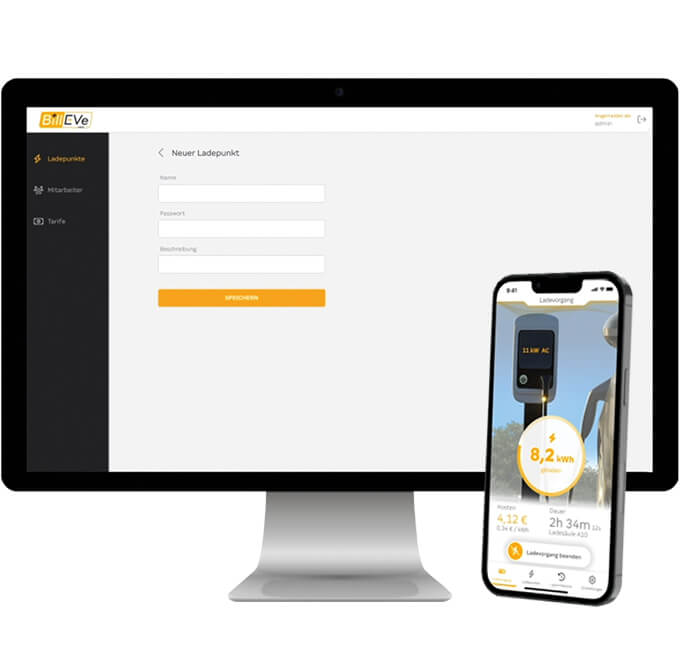
In addition, current charging station statuses can be conveniently monitored from the workplace via the BillEVe administration frontend. The system also enables users to view revenues and analyze charging transactions in a clear and efficient manner.

After the successful completion of the test phase and the full technical migration, the new employee tariff was made available to the entire workforce. Interested employees were able to register easily with the energy team and were subsequently activated in the system. At the same time, one charging station at each location remained publicly accessible, allowing guests and external users to charge their vehicles on site.

A key element of the solution is the simple user identification process. Employees can use their existing company transponders to authenticate themselves at the charging stations, eliminating the need for additional apps, charging cards, or external payment systems. User management and tariff assignment are handled centrally through the system, significantly reducing the administrative workload for those responsible.

In addition, current charging station statuses can be conveniently monitored from the workplace via the BillEVe administration frontend. The system also enables users to view revenues and analyze charging transactions in a clear and efficient manner.

“With BillEVe, charging is particularly convenient. After the one-time activation, everything works quickly and reliably, while the app provides full transparency on charging sessions and costs at any time.“

Detlef Jockjeck

Team Leader IT Support (adp)

Result

The introduction of the employee tariff was very well received by the workforce. Shortly after the go-live, more than 50 users had already registered for the service. At the same time, utilization of the charging infrastructure increased significantly. For many employees, charging their vehicles at the workplace has now become a natural part of their daily routine.

A key success factor is the high level of user-friendliness offered by the solution. By using their personal company transponder, employees can quickly and easily authenticate themselves at the charging stations. The previously required use of apps or external payment methods has been completely eliminated. This significantly lowers the barriers to using the charging infrastructure and ensures a convenient charging experience.

The processes on the administrative side have also been greatly simplified. All charging costs incurred are automatically recorded and billed securely via the monthly payroll process. This eliminates a considerable amount of manual effort for both employees and the responsible departments. The automated processing ensures transparent and traceable procedures as well as reliable cost allocation.

Additional transparency is provided by the BillEVe app. Employees can access their personal charging history at any time and keep track of all charging sessions and the associated costs. This strengthens confidence in the billing process and ensures full traceability of all transactions.

Furthermore, the conversion opened up new economic opportunities. By eliminating external backend costs, the MERKUR GROUP was able to offer an attractive and discounted employee tariff. This not only increased the utilization of the existing charging infrastructure but also created additional value for the workforce.

The project demonstrates how companies can make their charging infrastructure significantly more attractive through digital and automated processes. With BillEVe, the MERKUR GROUP successfully increased the sustainable use of its existing charging points, simplified administrative processes, and at the same time established a transparent, convenient, and economically attractive charging solution for employees.

Become a BillEVer: billeve.de/en

Share :